

One search for the whole food industry, and a way in for everyone who serves it.
- Marketplace Platform
- Strategy
- Product Design
- UX/UI
- Client:
- Surch Foods Inc.
- Sector:
- Food & beverage B2B marketplace
- Scope:
- Marketplace Strategy, Design and Build
- Year:
- 2026
A two-sided B2B marketplace where anyone in the food industry can search products, ingredients, packaging, manufacturers, experts and services in one place. Built so buyers find by capability, not company name, and so every kind of business on the other side has a clear, honest reason to list.
CHALLENGE
When finding a supplier depends on who you already know.
Surch Foods was founded by a food-industry insider with nearly two decades in private label product development and bakery R&D. She had watched the same problem play out at every company she worked for. Buyers couldn't find the right supplier. Good suppliers couldn't get found. And the expertise that could solve both sat hidden inside other people's contact lists.
Sourcing in food still runs on trade shows, old spreadsheets, broker relationships and generic web searches that return company names, not capabilities. A brand looking for a low-MOQ beverage co-packer with SQF certification in Ontario has no single place to ask that question. The idea was clear: one search engine for the whole food industry. The hard part was that "the whole food industry" isn't one audience. It's at least six, and each needs something different from the same platform.
-
Challenge 01 Six audiences, one front door: "Who is this site for?"
Buyers, suppliers, manufacturing partners, distributors and brokers, service providers and experts all needed to land on the same platform. Speak to everyone at once and you convince no one.
-
Challenge 02 Searching by name, not need: "I don't know who makes it. I know what I need made."
Buyers rarely know a supplier's name in advance. They search by capability: a process, a format, a certification, a run size. Keyword search on company names misses almost every real query.
-
Challenge 03 A cold-start marketplace: "Why list if nobody's searching?"
A two-sided marketplace has to give suppliers a reason to join before buyer traffic is proven, and give buyers a reason to search before every category is full.
-
Challenge 04 Trust without a track record: "Who are these people?"
A new platform full of companies most buyers have never heard of can't lean on famous logos. Credibility had to come from the profiles, the founder and how the product itself behaves.
Without Surch
- Sourcing through trade shows, brokers and personal networks
- Generic web searches that return company names, not capabilities
- Suppliers, co-packers and experts listed in separate, scattered directories
- No way for a small manufacturer to show what it can actually make
- Commission-based platforms that take a cut of every relationship

With Surch
- One search across products, companies and experts
- Results and filters built around capability, format and certification
- A dedicated path for each of six audiences, from first click to profile
- Profiles that show products, processes, certifications and documents upfront
- Flat subscriptions, no commission, a direct line between businesses

DIAGNOSIS
Three problems inside one big idea.
Before designing a page, we mapped the journey of every audience the platform had to serve: what each one arrives looking for, what they need to see to trust it, and the one action that counts as success. Six journeys, side by side, made it clear the work wasn't one design problem. It was three.
-
The routing problem
Six audiences can't share one pitch. A lab-testing service and an ingredient supplier have almost nothing in common, yet both need to recognise themselves within seconds and find a path written for them.
-
The search problem
The platform's core promise is search, so search had to work the way buyers think. That meant structuring results, filters and profiles around capabilities, formats and certifications, not just matching keywords.
-
The supply problem
A marketplace is only as good as its listings. The supply side needed a clear, low-risk reason to join on day one: affordable flat pricing, no commission, and a profile that does real selling work.






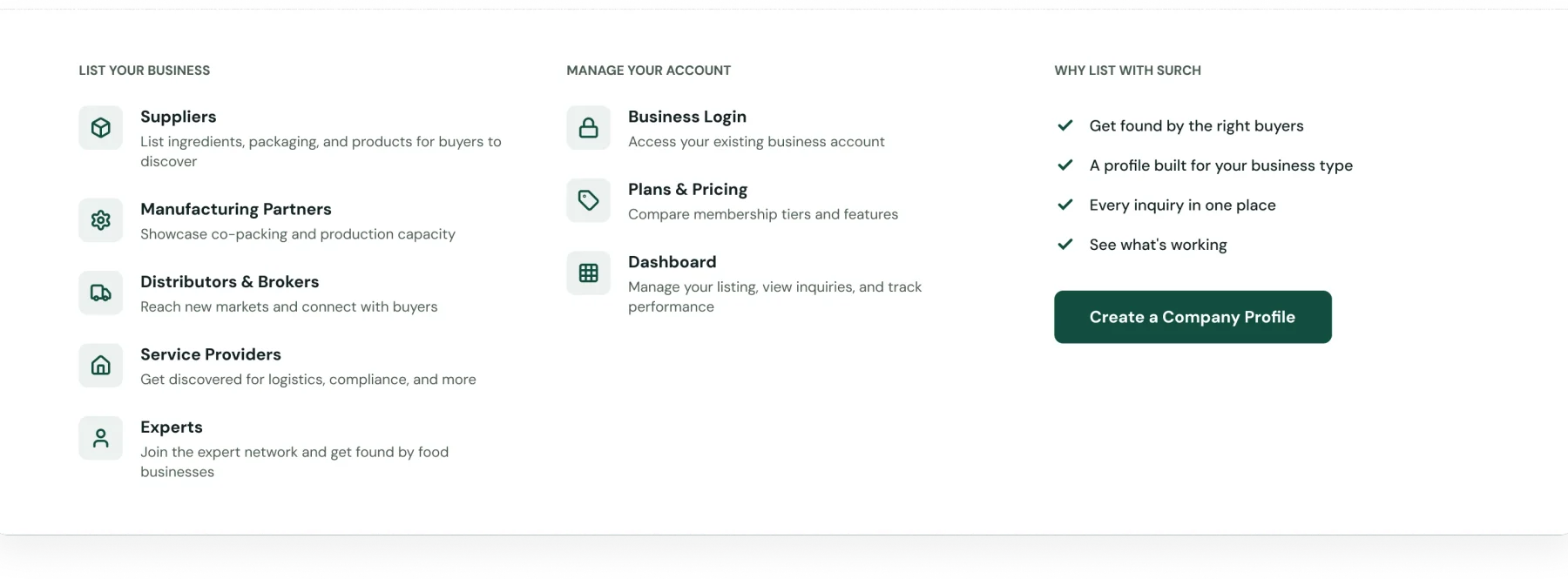

The tension running through all three was the same: how do you build one platform that feels made for six different businesses, without turning the homepage into a directory of everyone? That question shaped every structural decision that followed.
IMPLEMENTATION 1
Search first. Then a door for everyone.
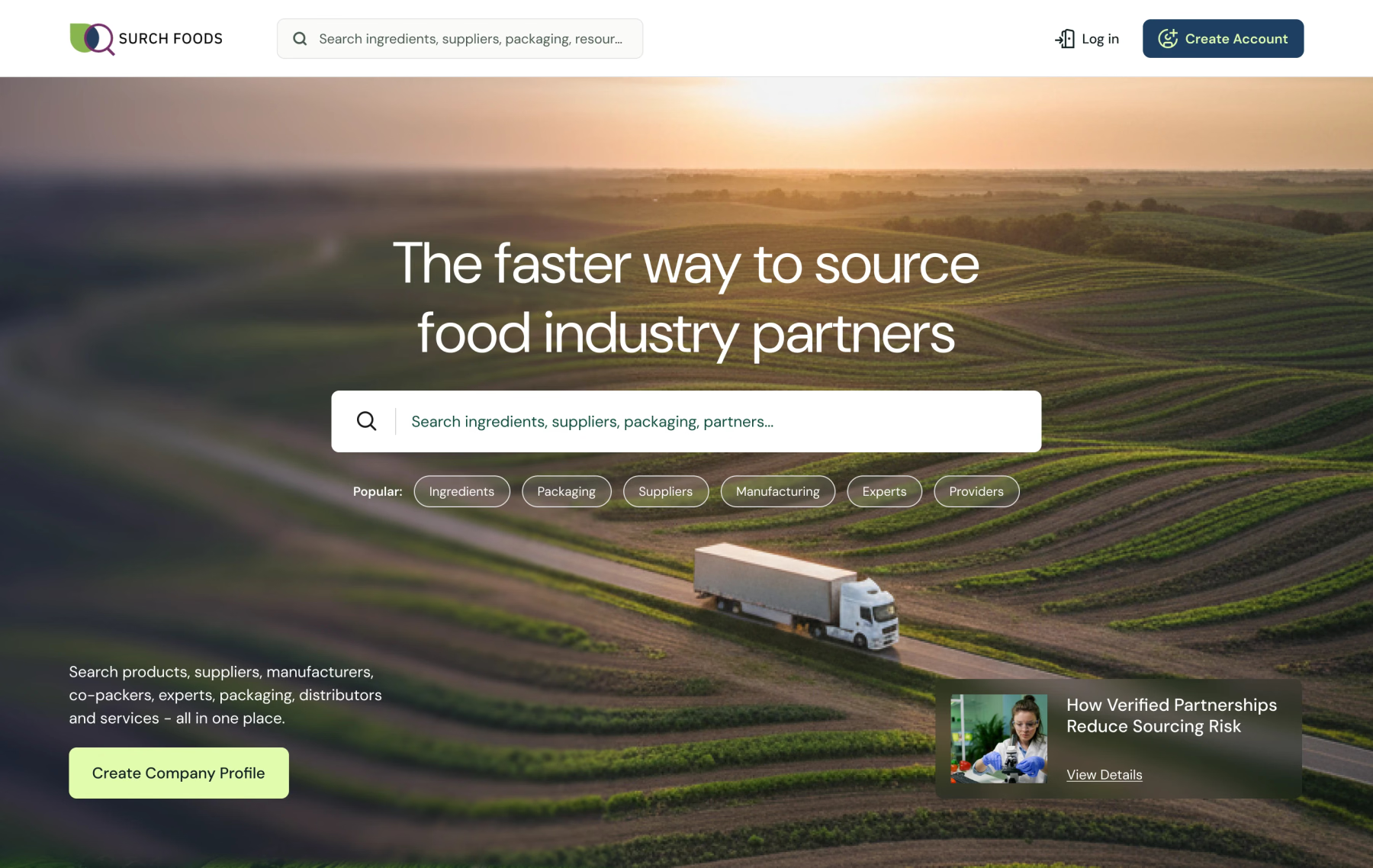
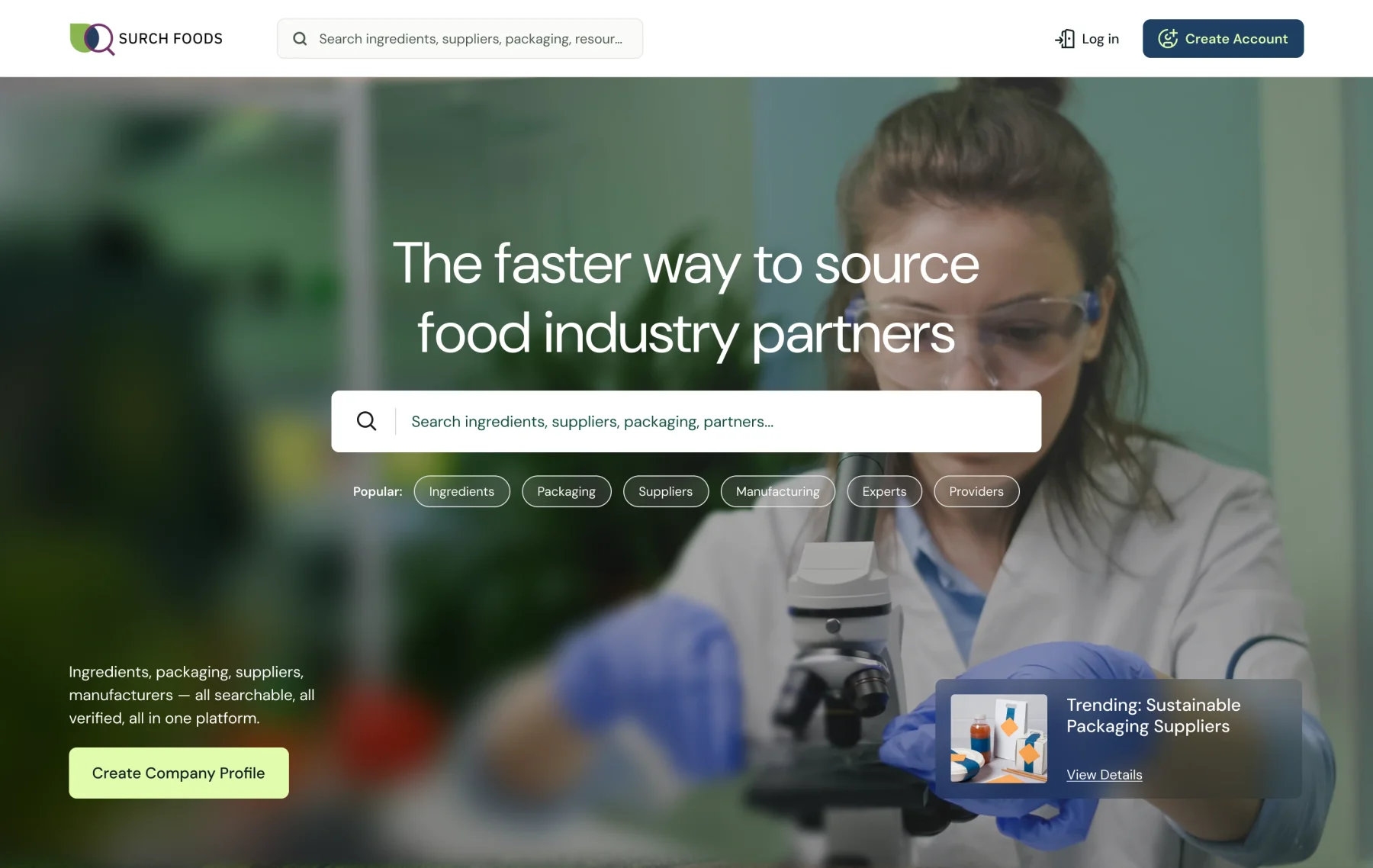
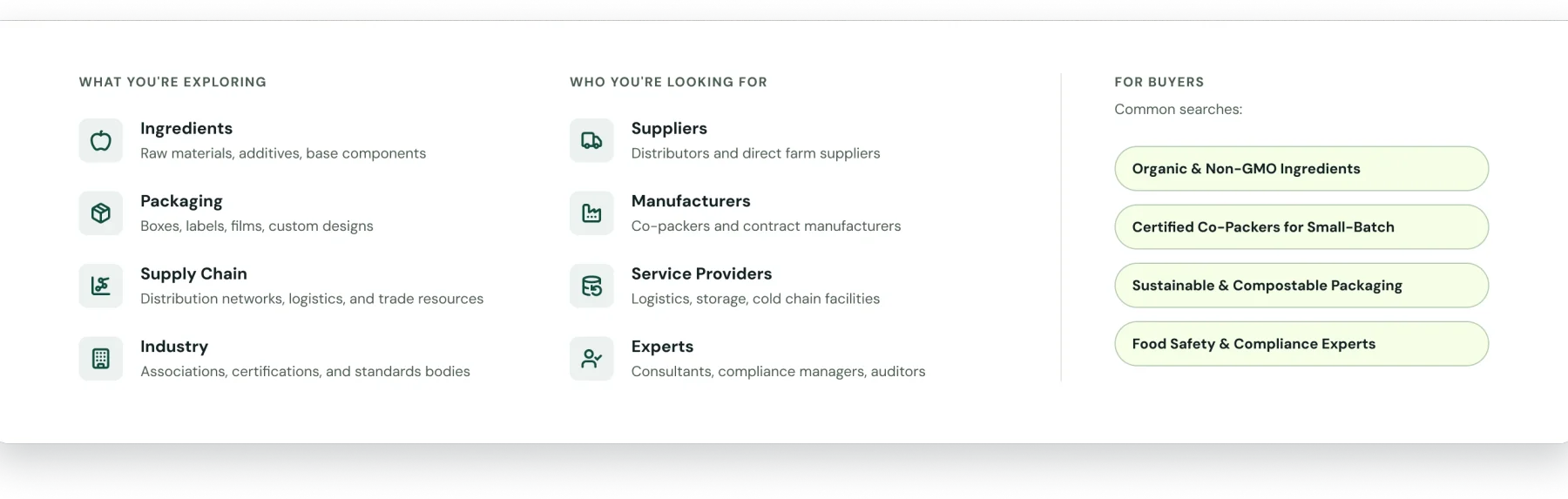
The homepage had to do two jobs without letting either crowd the other. For the buyer, the answer is search, so search leads: one bar in the hero, eight categories underneath, and a row of common searches like co-packers, cocoa powder or regulatory experts that turn a blank box into a first click.
For everyone on the other side, the homepage asks one question: which are you? Each audience gets a card in its own language and a link to a landing page written only for them. Instead of six pitches stacked on one page, the homepage stays short and the depth lives one click away.
| Demand side | Supply side · lists to be found | |||||
|---|---|---|---|---|---|---|
| Buyer | Supplier | Manufacturing Partner | Distributor & Broker | Service Provider | Expert | |
| Entry point | Search bar on the homepage, or a Google search for a capability | "For Suppliers" audience card | "For Manufacturing Partners" audience card | "For Distributors & Brokers" audience card | "For Service Providers" audience card | "Join the Expert Network" audience card |
| Key question | “Can I find exactly what I need here, fast?” | “Will buyers actually find my products here?” | “Can I be found for what I can make, not just my name?” | “Will brands looking for market reach find me?” | “Do food businesses search for services like mine here?” | “Will the right companies find my expertise?” |
| Proof needed | Relevant results grouped by products, companies and experts; specs and certifications on the profile | Real buyer searches, what a product listing shows, flat pricing, no commission | Capability-based search examples, 12 partner types, answers on MOQs and facilities | Space to show distribution, brokerage and route-to-market capabilities; direct contact | Service categories they recognise: lab testing, logistics, design, legal, regulatory | A searchable expert profile, filtered by project type: R&D, regulatory, commercialization |
| Primary action | Search & message a supplier | Create company profile | Create manufacturing profile | List your business | List your services | Create expert profile |
Demand side
Buyer
- Entry point
- Search bar on the homepage, or a Google search for a capability
- Key question
- “Can I find exactly what I need here, fast?”
- Proof needed
- Relevant results grouped by products, companies and experts; specs and certifications on the profile
- Primary action
- Search & message a supplier
Supply side · lists to be found
Supplier
- Entry point
- "For Suppliers" audience card
- Key question
- “Will buyers actually find my products here?”
- Proof needed
- Real buyer searches, what a product listing shows, flat pricing, no commission
- Primary action
- Create company profile
Supply side · lists to be found
Manufacturing Partner
- Entry point
- "For Manufacturing Partners" audience card
- Key question
- “Can I be found for what I can make, not just my name?”
- Proof needed
- Capability-based search examples, 12 partner types, answers on MOQs and facilities
- Primary action
- Create manufacturing profile
Supply side · lists to be found
Distributor & Broker
- Entry point
- "For Distributors & Brokers" audience card
- Key question
- “Will brands looking for market reach find me?”
- Proof needed
- Space to show distribution, brokerage and route-to-market capabilities; direct contact
- Primary action
- List your business
Supply side · lists to be found
Service Provider
- Entry point
- "For Service Providers" audience card
- Key question
- “Do food businesses search for services like mine here?”
- Proof needed
- Service categories they recognise: lab testing, logistics, design, legal, regulatory
- Primary action
- List your services
Supply side · lists to be found
Expert
- Entry point
- "Join the Expert Network" audience card
- Key question
- “Will the right companies find my expertise?”
- Proof needed
- A searchable expert profile, filtered by project type: R&D, regulatory, commercialization
- Primary action
- Create expert profile
Every audience path follows the same pattern: their problem → how Surch solves it → what their profile shows → proof → pricing → CTA. The design system keeps that structure consistent; the content, examples and imagery change per audience.
ONE PAGE FOR EVERYONE — Audience Last
- A single "Join" page for every business type
- Product-listing pitch shown to consultants and labs
- Buyers and sellers mixed in the same navigation
- CTA: "Sign up"
A PATH FOR EACH — Audience First
- For Buyers: "I need to find it fast"
- For Suppliers: "I need buyers to find my products"
- For Manufacturing Partners: "I need to be found for what I can make"
- For Distributors & Brokers: "I need to reach the right markets"
- For Service Providers: "I need food businesses to know I exist"
- For Experts: "I want my expertise to be searchable"

Implementation 2
Built for how buyers actually search.
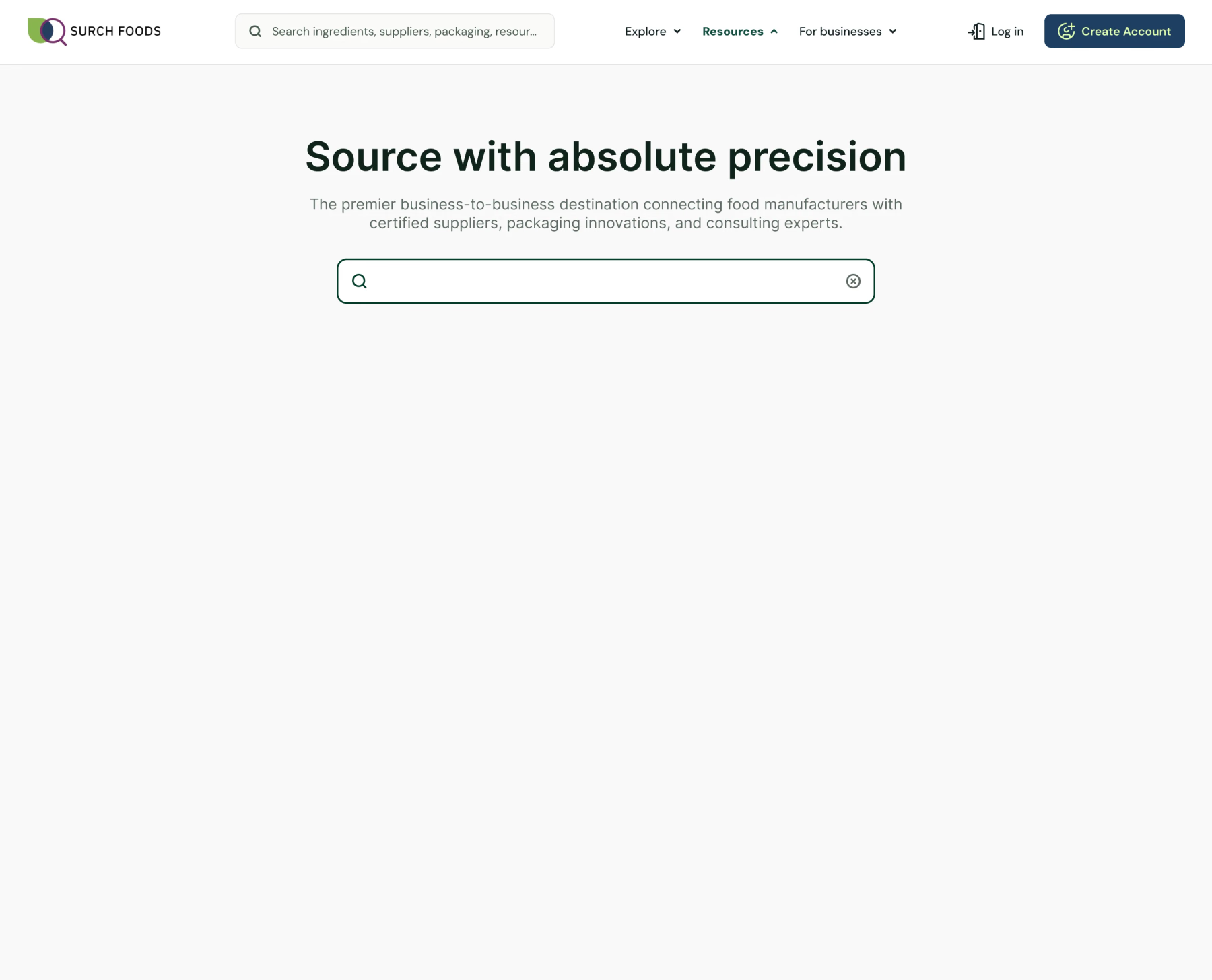
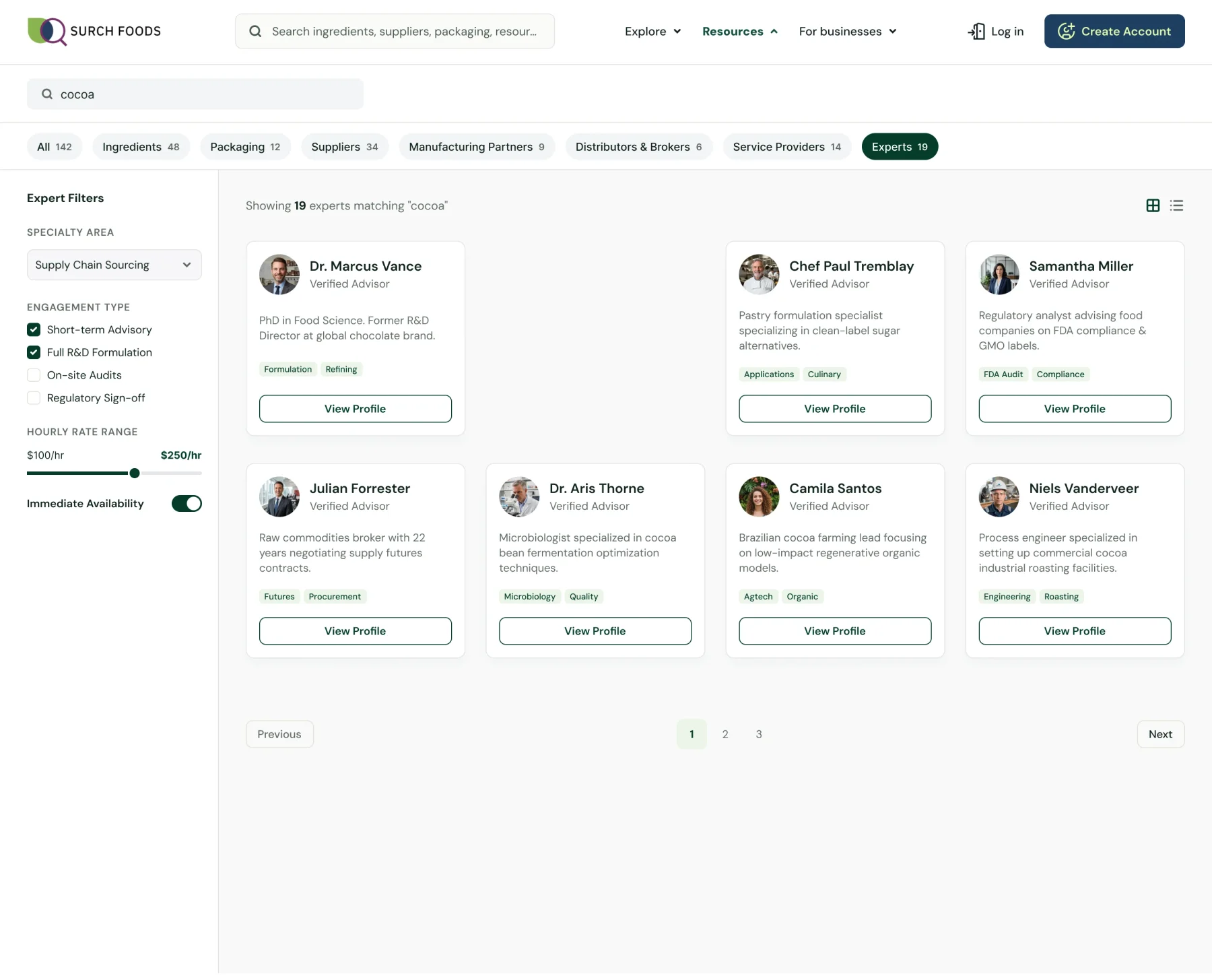
Nobody in food sourcing searches for a company name. They search for a gluten-free cracker manufacturer, a flow-wrap contract packager, or a sauce maker with SQF certification. The search experience was built around that reality.
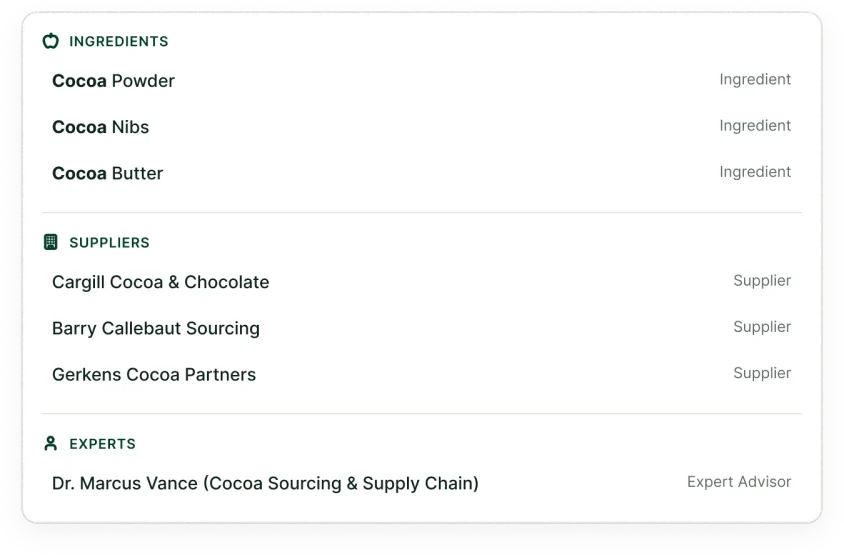
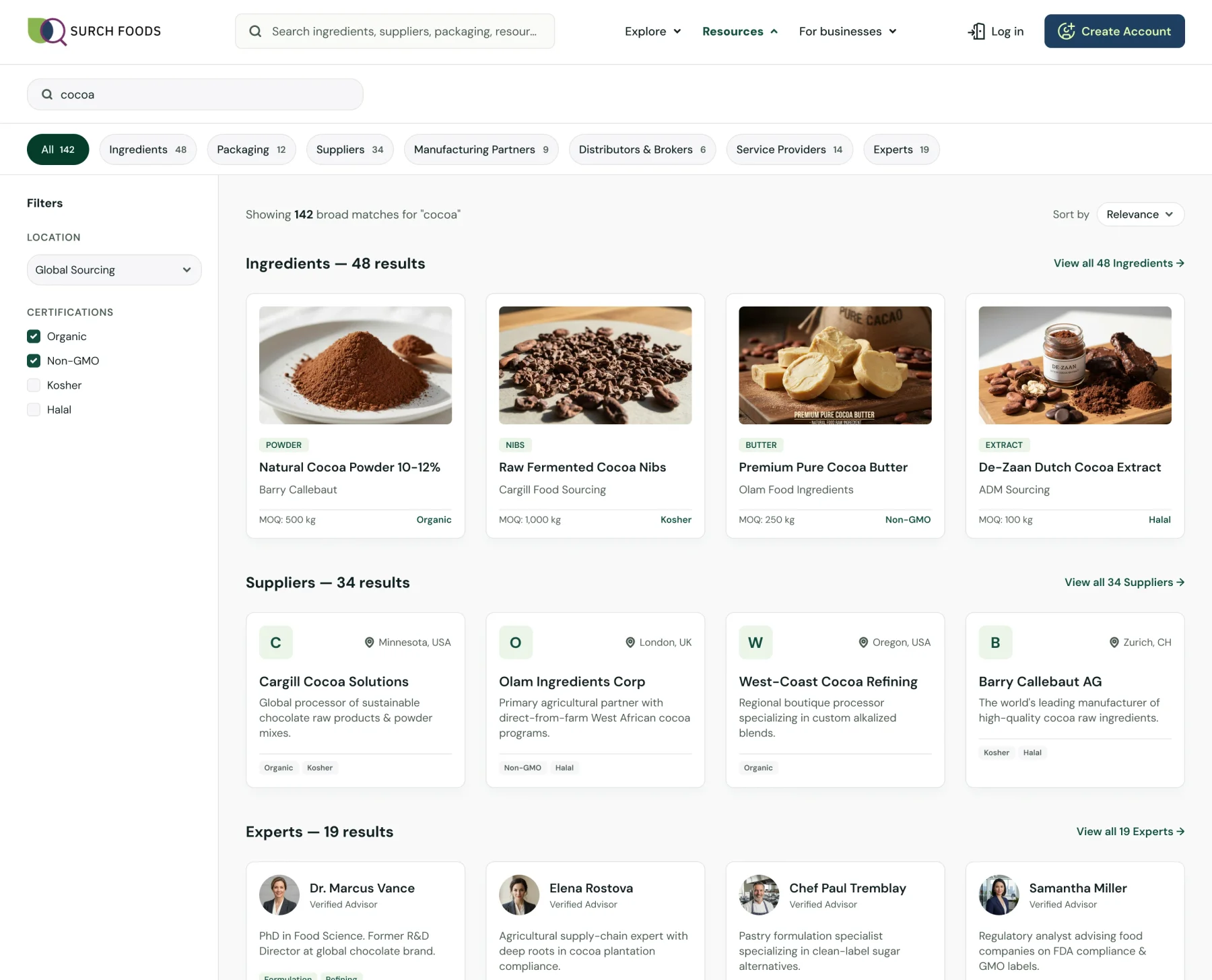
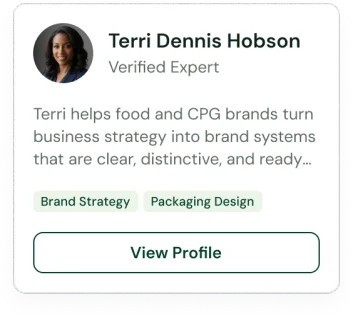
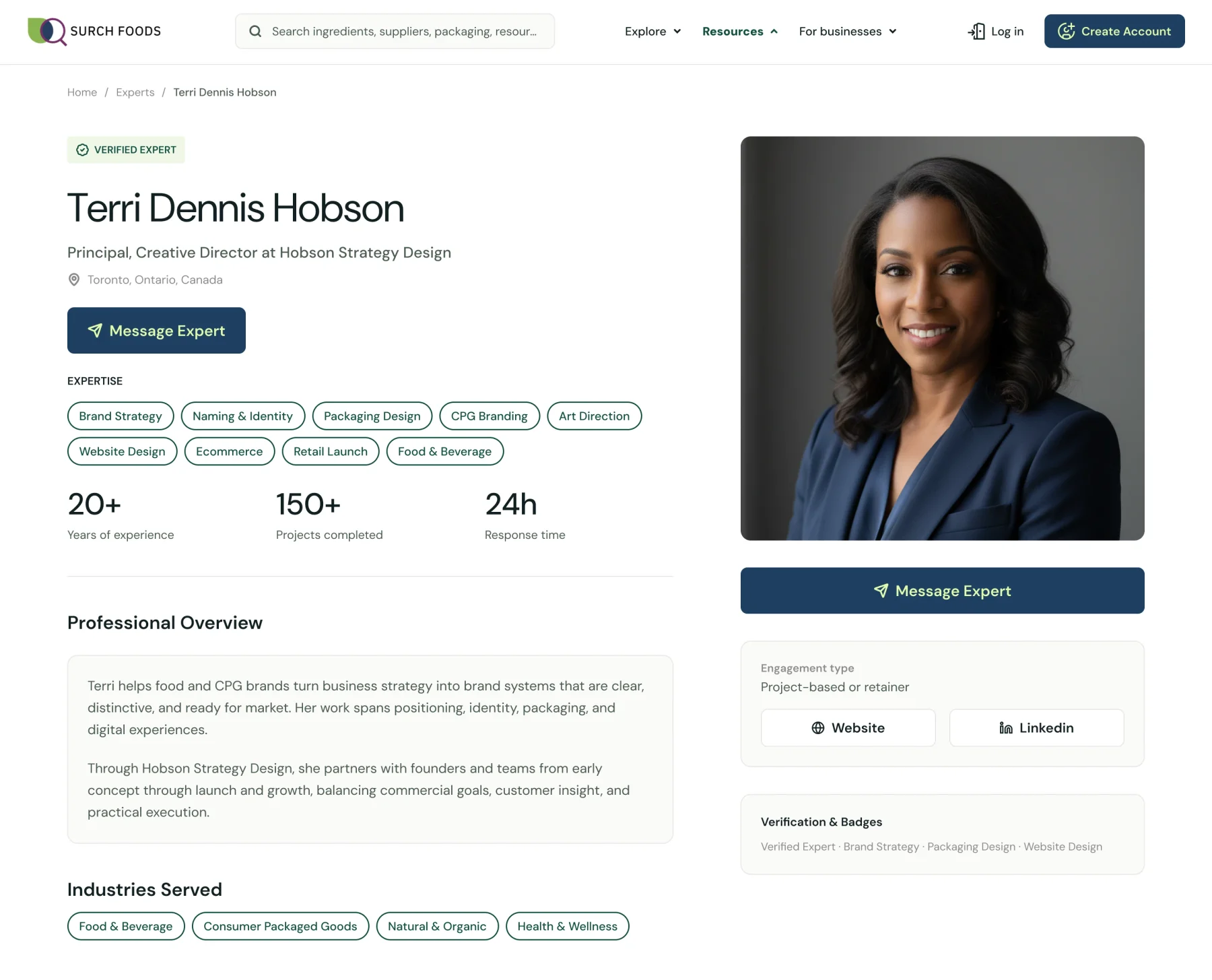
One search bar covers the whole platform, and results are grouped into three clear types: Products, Companies and Experts. Filters follow the attributes buyers screen on, such as product type, category, manufacturing process, packaging format and certification. Every result leads to a profile designed to answer the buyer's next question before they have to ask it.



-
Buyers get: Search that thinks in capabilities
- One bar across products, companies and experts
- Results grouped by type, not one long mixed list
- Filters for category, process, format and certification
- Common searches surfaced as one-click starting points
- Free to search, no account needed to browse
-
Profiles show: The full picture upfront
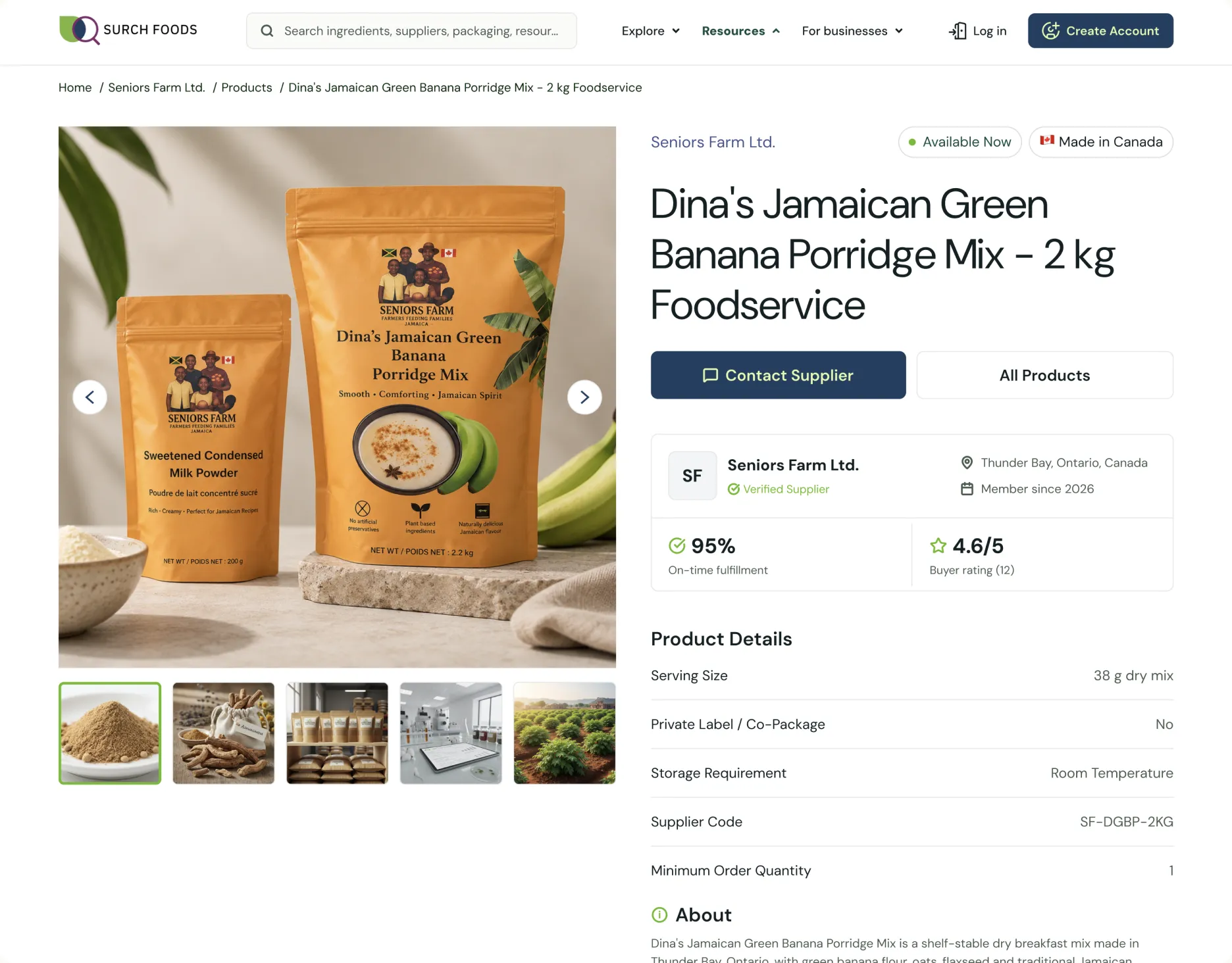
- Products, ingredients and packaging with images
- Manufacturing capabilities, processes and formats
- Certifications and documents on the page
- Direct messaging, no middleman
- SEO-optimised company pages that rank on their own
IMPLEMENTATION 3
Giving suppliers a reason to list on day one.
A new marketplace lives or dies on its listings. Each audience landing page was designed as a complete sales argument for one kind of business, built from the same template so new audiences can be added without new design work.
The Manufacturing Partners page shows how it works. It opens on the promise that matters to a co-packer: get found for what you can manufacture, not your company name. It names twelve kinds of manufacturing partner so each one recognises itself, shows real examples of how brands search for them, and answers the hard questions about MOQs, multiple facilities and commission before anyone has to ask.
-
Step 1 Recognise yourself.
An audience landing page written for one business type, with the searches buyers already run for them.
-
Step 2 Create your profile.
A guided company page, then products, capabilities and certifications.
-
Step 3 Appear in searches.
Listings surface when buyers search by product, process, format or certification.
-
Step 4 Connect directly.
Buyers message the business on the platform. The relationship and the deal stay between them.
The commercial model was designed to remove every reason to hesitate. Flat subscriptions from $29 a month, a Premium tier at $49, and an Enterprise tier for larger teams. No commission on any project or sale. Optional ad placements give suppliers who want more visibility a simple way to buy it.

CLIENT TESTIMONIAL
“I couldn’t ask for better partners in building Surch Foods.”
Working with Andrew and the team at Stiff Upper Lip has been an incredible experience, from our early strategy calls to seeing Surch Foods take shape through wireframes, design and development.
Andrew carefully mapped out how each type of user would navigate the platform, making sure every detail was discussed, planned and built with their needs in mind. His leadership has been thorough, professional and reliable, with integrity, thoughtful ideas and consistent follow-through throughout the project.
The team brings design and technical expertise together to create and adapt features, troubleshoot challenges and guide me through the right app integrations. If they don’t have an answer, they find a solution.
I truly appreciate how knowledgeable, thoughtful and collaborative they are, and I couldn’t ask for better partners in building Surch Foods.
DESIGN SYSTEM
Fresh, trustworthy, and built to scale.
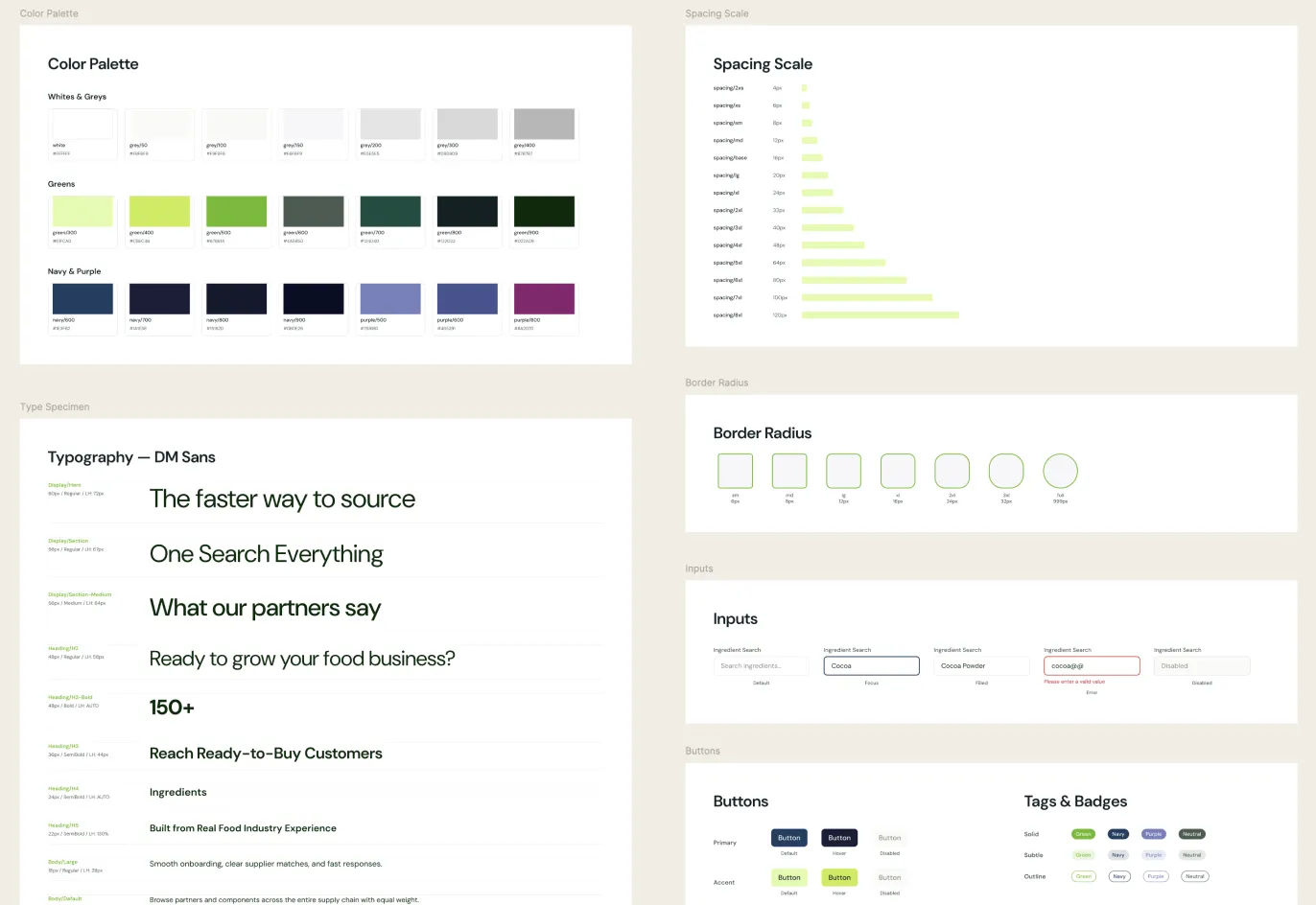
The visual system had to feel fresh enough for food and serious enough for procurement. It also had to stretch across a homepage, a search engine, six audience pages and hundreds of profiles without drifting. Everything was built from one source: the homepage defines every token and component, and no page invents its own.
-
01 — Colour
One Colour Means "Act"
Fresh green leads the brand and the interface. A deep plum is reserved for the single most important action on each page, and nothing else. The scarcer it is, the harder it works.
-
02 — Typography
Editorial Meets Utility
A serif display face for headlines gives the brand warmth and authority. A clean sans-serif carries the interface, filters and data, where clarity matters more than character.
-
03 — Components
One Card, Many Jobs
Product, company, expert and audience cards share one structure. Buyers learn the pattern once and can scan any results page or profile list at speed.
-
04 — Foundations
Built on Tokens
Colour, type, spacing, radius and effects live as Figma variables, mapped one to one in the build. New audience pages and features are assembled from the system, not designed from scratch.
The outcomes
A marketplace where the whole food industry can find each other.
-

One search for the whole industry
Products, ingredients, packaging, manufacturers, experts and services sit behind a single search bar. A buyer no longer needs five directories and a phone list to start sourcing.
-

A path for every audience
Six audiences each have a landing page written for their business, so a co-packer, a lab and a consultant all recognise themselves within seconds instead of reading someone else's pitch.
-

Search built on capability
Results grouped into products, companies and experts, with filters for process, format and certification, match how buyers actually describe what they need.
-

Profiles that do the selling
Capabilities, certifications, documents and direct messaging are on the page, so buyers can shortlist before the first conversation.
-

A model suppliers can say yes to
Flat subscriptions from $29 a month and zero commission give businesses a low-risk reason to list from day one, and keep every customer relationship theirs.
-

A system that grows with the platform
One token-based design system powers every page. New audiences, categories and features can be added without breaking the hierarchy or starting from a blank canvas.
Surch launched as what its founder set out to build: a search engine for the food industry, not another directory. Buyers search the way they think, and every business on the other side has a clear, fair reason to be found. The work brought Technology Strategy and Software Design & Build together, from the marketplace model to search and profiles.